Tuesday, November 1, 2011

3 The Chevalier Sisters: War in the West

An 1812 Battle in the Old Northwest

The French and the Native Tribes were important additional players in the British-American War of 1812. We have a hard time imagining the size of the early-19th-century Native American presence in the area known as the Old Northwest (Ohio to Wisconsin) because most tribes were forced further west in continuing Indian removals. Today's faded memory of that once-dominant culture is in the Indian names on rivers and towns.


Gallatin's map of the tribes near the Great Lakes

The early 19th-century tribes were certainly not a single power. Each had varying goals, economies and allegiances. England and Canada used diplomacy, threats, trade and tributes to ally Indians for their own purposes, policy that rankled Americans after the Revolutionary peace, another cause of hostilities leading to the 1812 War.

Francis Godfroy, a Miami-French trader
in a combination of Native and mainstream dress

The French remaining after the 1803 Louisiana Purchase also attempted to influence tribal allegiances. One remaining French presence was a population of Métis (people of mixed ancestry.) For generations Indian and French people intermarried, creating a unique culture that thrived along the waterways of Canada and the Midwestern states, as far west as Saint Louis and down to the Gulf of Mexico. The economy prospered on trade---furs and pelts exchanged for manufactured goods---with Métis acting as the go-betweens and translators.

The Chevalier sisters of Potawatomie and French descent were born in what we call Michigan in the 1780s. Archange Marie and Suzanne Françoise were daughters of a French trader and a Potawatomi woman who themselves were probably of mixed parentage.


The Ouilmette name lives on in Wilmette, Illinois.
 Postcard from about 1920.

Archange Chevalier married Canadian Antoine Ouilmette in 1796 and settled near the mouth of the Chicago River at the southern edge of Lake Michigan (we call it Chicago) where Antoine worked for an American trader named John Kinzie. Suzanne, called Sheshi, married Louis Pierre Buisson, also a Canadian trader. Louis traveled from Peoria to Mackinac, often selling goods to Kinzie.

A mid-19th century interpetation of Fort Dearborn on the Chicago River

American Fort Dearborn protected Kinzie's trading post and the small lakefront village with a few Americans and Canadians of English descent living among mixed families. The French/Indian people tried to maintain peace and a make a profit by cooperating with the people of English descent and the Indians who resented American and British presence.


War shifted all allegiances. American commanders realized overtly hostile English influence over the local tribes made Fort Dearborn indefensible. Negotiating with Potawatomi elders, they traded a promise of American safe passage for goods stored at the Fort, "blankets, broadcloths, calicos, paints, etc.,"

The 1812 violence at Fort Dearborn
is remembered in a 1928 sculpture by Henry Hering,
built into the southwest tower of Chicago's Michigan Avenue Bridge.

Before leaving, the Army destroyed ammunition and liquor, a breach of promise according to younger Indians. Shortly after the Americans started out on August 15, 1812, violence exploded near Prairie Avenue at 18th in today's geography.

Women and children were fair game. Eighteen-year-old Margaret McKillip Helm survived only because Potawatomi leader Black Partridge pretended to drown her while supporting her head above the water. For reasons never explained he singled her out for protection, hiding her at Archange Ouilmette's house.

American Juliette Kinzie later wrote an account of Margaret's escape. Black Partridge advised her to "assume the ordinary dress of a French woman of the country; namely, a short gown and petticoat, with a blue cotton handkerchief wrapped around her head."


My guess: Native costume in Chicago
 was similar to that of the Dominican woman on the left.
The words short gown refer to her jacket,
a rather old-fashioned working-class garment
by 1812. Her mistress is more fashionably dressed.

Even clad in French/Indian attire Margaret's pale complexion would not fool the young warriors, so sisters Archange and Suzanne hid her under a mattress. Suzanne "then seated herself with her sewing upon the front of the bed."


The Kinzie's House from Juliette Kinzie's book

" The Indians entered, and [Margaret] could occasionally see them from her hiding-place, gliding about, and stealthily inspecting every part of the room...until apparently satisfied that there was no one concealed, they left the house.

" All this time [Suzanne Buisson] had kept her seat upon the side of the bed, calmly assorting and arranging the patchwork of the quilt on which she was engaged, and preserving an appearance of the utmost tranquility, although she knew not but that the next moment she might receive a tomahawk in her brain. Her self-command unquestionably saved the lives of all present."

I  know too little about frontier history to judge the accuracy or even the plausibility of this tale published 30 years later by Juliette Kinzie who heard it from her husband's family. Narrative of the Massacre at Chicago, August 15, 1812, and of Some Preceding Events followed the period formula about white/Indian encounters, justifying Indian removal by their unpredictable violence while lauding a noble exception (Black Partridge.)


Juliette Kinzie 1806-1870
A founder of the Chicago Historical Society

If Suzanne Buisson were indeed sorting her patchwork scraps near Lake Michigan in 1812 she was likely using the printed cottons in stock at Fort Dearborn and the Kinzie store. One of calico's major markets was as trade goods and gifts for the tribes.


Tintype, Native American man
wearing a cotton shirt, late 19th century


We have no surviving early quilts from Native women or women of the French/Indian culture, although they might have made them. I find Mrs. Kinzie's story a bit suspect but we can remember the Chevalier sisters and their culture by finding inspiration in the crafts of Native Americans.

Epaulette

The imagery in these two embroidered pieces is based in tradition from India and Asia, adapted by European cultures and then by Native American artisans. The basic symmetries and simple floral shapes are often found in applique and embroidered quilts.


 Two 19th-century Native American needlework items
 from the collection of the McCord Museum in Montreal.
See a link below.

One could combine the Native American imagery as embroidery or applique in the central medallion format.

This quilt is dated 1822,  made by Margaret Nowlan in Maumee, Ohio, and in the collection of the Smithsonian according to my notes. Although it's dated 10 years after the violence at Fort Dearborn the design seems very much of our period. The simple borders would be an excellent way to frame a piece of embroidery inspired by the Native American designs.


Here's the corner of a medallion with an embroidered center from dealer Jan Whitlock's webpage. Click here to see the full quilt. It's on the bottom row of the thumbnail pictures.

Medallion with an embroidered center signed Mary Jones and dated 1795
The curators at the Art Institute of Chicago, where this quilt top is now, believe the patchwork was added twenty or so years later. Click here to see it at their site:


Virtual quilt

I did a little Photoshopping here, plopping my virtually appliqued and embroidered center
 into a top I started a few years ago. The Native American imagery is a little more modern to our eyes than the embroidered centers in the quilts above---less clutter, more visual shorthand for flowers.

But back to the Chevalier sisters...
During and after the War the women who lived near the Kinzie store remained near Lake Michigan. In 1829 Archange Ouilmette was granted land along the shore in what is now Wilmette. The family farmed there for about five years until the Potawatomi were again moved, sent west of the Mississippi River. Archange died in 1840 in western Iowa near the Missouri River.

Suzanne Buisson's husband continued as a trader with the American Fur Company in the Chicago/Peoria area but Sheshi disappears from the records.  Margaret Helm and her husband remained in Chicago but their marriage was unhappy. She obtained a divorce in the 1820s.

The Potawatomi were moved again
 in the 1840s to Kansas. Photograph about 1865.


Links
-Here's a comprehensive site to people, places and events in Early Chicago
http://www.earlychicago.com/


-Read Juliette Kinzie's Narrative of the Massacre at Chicago, August 15, 1812, and of Some Preceding Events
http://www.archive.org/details/narrativeofmassa00kinz


See another epaulette at the McCord Museum in Montreal by clicking here:
http://www.mccord-museum.qc.ca/en/collection/artifacts/ME938.1.12.1-2

The Royal Ontario Museum has many needlework objects by Native Americans. Click here
http://images.rom.on.ca/public/index.php?function=browse&action=selected&tbl=aa&filter=aa_coll&fid=5&sid=&ccid=
and browse through Decorative Arts
See another idea here:
And this blog shows an embroidered sampler made by a girl born into the traders' culture in 1810.
http://wisconsinobject.wordpress.com/2009/03/18/favorite-finds-1/

One hundred years later a Sioux woman from the Standing Rock area in the Dakotas posed with  needlework for photographer Frank Fiske. The interplay between European and Native American imagery continues.

Tuesday, October 25, 2011

More Eagles for Ideas

 Eagle and Stars Center Medallion,
Martha Randall Chesebrough, ca. 1808, 99” x 93”
Collection of the Fennimore Art Museum


This eagle quilt,  similar to others from the first decades of the 19th century, will be on display through the end of the year at the Farmer's Museum in Cooperstown, New York.
Unfolding Stories: Culture and Tradition in American Quilts "organized by renowned quilt scholar Jacqueline M. Atkins, the Fenimore Art Museum for the first time in over 15 years will display selections from its large collection of quilts. The exhibition will address themes of diversity, ethnicity and culture. Also included are the three award-winning quilts from the 2010 New York State of Mind Quilt Show." Through December 31, 2011.
Click here for more:
Here's one from the collection of the Benton County Historical Museum in Oregon. Again it's an interpretation of the Great Seal of the U.S. with a combination of cut-out chintz applique (in the border blocks) and conventional applique in the eagle and stars. See their post on it here:

" Label on back, bottom right: 'Aunt Maggie gave this 1918 over 100 years old.' "

If Aunt Maggie is right the quilt would be from the teens. The fabric is very worn and the photos don't give us enough detail to determine the age but the quilt could be a souvenir from the patriotic wave of the War of 1812. Or it could be a "Union quilt" from the Civil War era, fifty years later.

Scroll through their collection which features several nice quilts, including another early example, a cut-out chintz medallion with a Greek key border.

This last one is from an online auction a while back.
Could be early---I see no fabric or patchwork ideas in this snapshot that conflict with a "first quarter of 19th century date" although a detailed examination might reveal those pink and brown prints are late-19th century.

Sunday, October 16, 2011

Five Popular Blocks for Martha's Quilt


EQ sketch of Martha's quilt

Although the Penn's Treaty Quilt attributed to Martha Washington was made at least ten years before the War of 1812, its general medallion design alternating pieced and unpieced borders around a piece of toile  would remain fashionable until the 1840s.


This similar Virginia quilt is dated to the 1840s.
Collection: Virginia Quilt Museum.


Medallion from an online auction a few years ago
 also  features flying geese with stars
 in the corners, the same border Martha used.


The five blocks that appear in Martha's pieced borders---basic patchwork of squares and triangles---are among the oldest designs we find in American quilts.  These classics remain popular.


Measurements (All are Finished Measurements so add seams)

See the measurements for the unpieced strips and center in the last post. Notice the unpieced strips have contrasting squares (cornerstones) in the corners.
 
Below is information for the alternate pieced borders.
 
Border B:

You will need 12 Square in a Square blocks finishing to 3".
Pieced Border = 3". Three pieced square in a square blocks in the center of each side. The rest may be strips or scrappy squares finishing to 3". The 4 borders measure 30" without the cornerstones. Border makes quilt 36".
      
 
Border D: 

You will need 4 star blocks finishing to 4" for the cornerstones in the borders.

For the strips you need flying geese rectangles (D) finishing to 2" x 4". You'll need 10 of these rectangles per side, 40 in all. The picture above shows two of the rectangles.
4" Border makes quilt 48".
 

Border F:
You will need 4 cornerstone stars finishing to 6"
 

And  32 square in a square blocks finishing to 6". 


Martha added extra pieced rectangles to adjust for this border's length. For these piece 8 flying geese rectangles 3" x 6" (Martha seems to have chopped hers off to fit.) Border makes quilt 64 1/2".
 
Border G:

This border is mostly unpieced strips finishing to 2-3/4". Each of four strips finish to 64 1/2" without the cornerstones. But she has pieced some rectangles into the corners of her strips here. Maybe, piece each 64 1/2"strip with corner rectangles of  5" brown strips finishing out the ends of 54 1/2" strips. Border makes quilt 70".


Border H:
 

You will need 28 pinwheel blocks finishing to 10".

And 4 four-patch blocks finishing to 10"  for cornerstones.
Border makes quilt 90".

Click here to see a medallion believed to be from North Carolina, date estimated to be 1820-1840  from the International Quilt Study Center and Museum collection (#2004.048.0007).
http://cdn.firespring.com/images/2d6e6d78-d689-4c8f-9941-34b872951636.jpg

Here is another medallion from about the same time that may be American or English in the collection of the Winterthur Museum. It features a toile center like Martha's and is thought to be from the same period.
http://content.winterthur.org:2011/cdm/singleitem/collection/quilts/id/374/rec/56

Click here for a Virginia medallion made by Rebecca Ellen Davenport Blackwell from the collection of the Museum of the Daughters of the American Revolution.
http://www.quiltindex.org/fulldisplay.php?kid=46-7A-9A
  • ,


Sunday, October 9, 2011

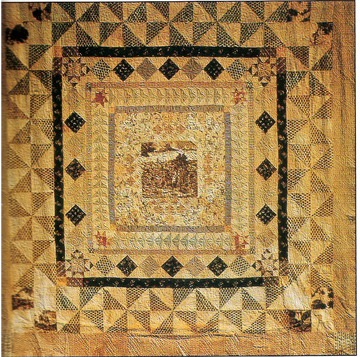
Martha Washington's Penn's Treaty Quilt


Penn's Treaty Quilt
Attributed to Martha Washington, estimated date 1785.

Reading a 1905 biography of George Washington's secretary and in-law Tobias Lear, I came across a picture of this quilt. It's quite familiar although I have never seen a good photo of it. The caption says it was made by Martha Washington and given by her to Mrs. [Frances Dandridge Henley] Lear.


Frances Dandridge Henley Lear
 1779 - 1856
Martha's sister's daughter.

Frances Dandridge Henley, Martha Washington's niece, was Tobias Lear's third wife. Louisa Lear Eyre, granddaughter through his first wife, wrote Lear's 1906 biography, Letters and recollections of George Washington: being letters to Tobias Lear ... explaining how she inherited this "very valuable and unique quilt, made by Mrs. Washington's own hands, which was used on George Washington's bed."


Penn's Treaty Quilt
Attributed to Martha Washington, estimated date 1785.
Collection of Mount Vernon Ladies Associaton
101" square

The quilt is now in the collection of the Mount Vernon Ladies Association which maintains Martha's home in Virginia. The pieced medallion is called the Penn's Treaty quilt because the central panel features a copperplate print of Pennsylvania's  founder Willliam Penn negotiating with the natives to establish a colony. Note one of the treaty gifts is a bolt of cloth in the center.


Above and Below: Two versions of the Penn's Treaty copperplate print.
The fabrics were printed at the end of the 18th century and reproduced several times.
Brown and red versions have been found.
The red one above may be a 20th century reproduction.


Winterthur Museum curator Florence Montgomery in Printed Textiles counted at least three versions. She found an ad from 1788 describing "One set of hair colour [brown?]  furniture cotton bed curtains, pattern William Penn's Treaty with the Indians. Three window curtains to match ditto." The seller: John Penn, Junior.


Diagram of the basic medallion
102" wide x 96" long

The quilt is hard to see in the photos but it's obvious that the composition is rather graceful and would make a good basis for a reproduction medallion. Martha alternated pieced and unpieced borders and used five of the most popular pieced blocks.  So I have drawn it up in EQ7 with pattern information below.

How old is it? It's attributed to about 1785, based on the first printing of the toile fabric (copied from a painting and a paper print of the Treaty.)The quilt would have to be before 1802 as Martha died in May that year and was not feeling particularly well in the months before her death. This is the kind of medallion that would remain fashionable into the 1820s. Later examples would feature more flamboyant chintzes and brighter colors. I would put the date as 1795-1800 based on the span between the toile's appearance and Martha's death.

The funniest thing I found in doing web searches for more information about the quilt and Louisa Lear was this review of her book from a periodical named The Reader.
"WE have heaped many absurdities upon that excellent—though dead—gentleman, General George Washington. We have perpetuated ridiculous juvenile lore about him, have dubbed him "a steel engraving." have eliminated his charm and his magnificence, and held him up to a disapproving generation as a prig, and now we have condescended to accept the very residuum of the most negligible portion of his correspondence concerning domestic affairs.
The Reader, obviously a very sophisticated magazine.

These letters, addressed to his secretary. Tobias Lear, were written in the belief that, their commands having been executed, they would be consigned to the files destined for destruction. They were fit for such uses, and for no others. They dealt with the minutiae of farms, stock, kitchen service, tailors, vehicles, comings and goings, tenants, lawsuits, etcetera, etcetera. They were quite distinctly the affair of General Washington and of no other living soul save those employed to carry out his wishes.
That the descendant of his secretary should betray this orderly, frugal landowner and housekeeper, making his economies known and his shifts common talk, is justified only by one incident. The incident is that this descendant, Mrs. Eyre, has a quilt made by the industrious hands of Martha Washington. The quilt is mentioned early and oft; a fullpaged illustration of the variegated horror is, with misplaced pride, given an honorable place.
Said "fullpaged illustration of the variegated horror"
One long neglected lady whose portrait is published is differentiated from the rest of her sex by the mention that she is one of the series of three wives essayed by Mr. Tobias Lear, and that it was she who was the recipient of the quilt shown in a foregoing illustration. There is a quality of mind that rejoices in dinky historical souvenirs of this sort, but the mutual felicitations of such, their exchanges of trivial confidences and secret heart-burnings, need not be intruded on those of more vital activities."

Well, now we remember why it was hard to get people to pay serious attention to women's work.
Read more of that issue of The Reader by clicking here:
http://books.google.com/books?id=ZtrlAAAAMAAJ&pg=PA458&lpg=PA458&dq=tobias+lear+letters+eyre+the+reader&source=bl&ots=Uyo1N0FwBY&sig=rhTFmKB0Wd143aFkoC2SIClk6YU&hl=en&ei=iAiOTvaQMtO9tgecpsSiDA&sa=X&oi=book_result&ct=result&resnum=5&sqi=2&ved=0CDcQ6AEwBA#v=onepage&q=tobias%20lear%20letters%20eyre%20the%20reader&f=false


The Plan for the Medallion
There are 9 borders A-I


Measurements (All are Finished Measurements so add seams)

The center finishes to 24" square.
A  Unpieced (?) Strips= 3". Longer one finishes to 30", shorter 24". There is some kind of pattern in Martha's border, possibly a light print. Border makes quilt 30".

B  Pieced Border = 3". Three pieced blocks (B)  in the center of each side. The rest may be strips or scrappy squares finishing to 3". The 4 borders measure 30" without the cornerstones. Border makes quilt 36".

C  Unpieced Striped strips = 2". Each 36" long. Add pinkish cornerstones. Border makes quilt 40".   
      
D  Pieced Flying Geese border (D) = 4". Cornerstone star (A) = 4" Border makes quilt 48".

E  Unpieced Striped strips = 2-1/4". Each 48" long. Add dark cornerstones. Border makes quilt 52-1/2"

F   Pieced Border = 6". Block F and Cornerstone star (A) = 6". There are odd extra pieces in the original to adjust for the size. For these modify Block E. Border makes quilt 64 1/2".

G  Pieced Border = 2-3/4". Each of four strips finish to 64 1/2" without the cornerstones. But she has pieced some rectangles into the corners of her strips here. Maybe piece each 64 1/2"strip with corner rectangles of  5" brown strips finishing out the ends of 54 1/2" strips. Border makes quilt 70". (Notice I drew the rectangles into strip G because I had a hard time figuring out how to show rectangles just in the corners)

H Pieced Strip = 10" Pinwheels (H) with Four-Patches (C) for cornerstones. Border makes quilt 90".

I Unpieced Border = 6". I see only three borders but the top may be cropped out of the photo. Strips of patchwork finish to 90" without the cornerstones. 3 borders make quilt 102" x 96".

More about the blocks in the next post in a week or two.


Saturday, October 1, 2011

2 Zebiah Smallwood Hewson: Domestic Manufacture

Cut-out chintz quilt with Hewson panel.
Smithsonian Institution. Gift of Patricia Melton Smith. Click here for more:

Philadelphia, the largest city in the U.S. about 1800


The young United States depended on the "carrying trade" for imports and exports. Tobacco and indigo shipped overseas paid for chintzes and china---luxuries that had become necessities. The continuing embargoes, sea battles and piracy that interrupted trade benefitted a few American merchants who could meet demand for domestic goods in the decades of the British Wars.

John Hewson (about 1744-1821)

Philadelphia's inland port was a center of industry. Among the workshops in the suburban industrial areas along the Delaware River was the Hewson "Calicoe Printing Manufactory and Bleach-Yard," a family operation since before the Revolution.


Document Hewson wood block print

Hewson matriarch Zebiah Smallwood Hewson was in her late fifties in 1812. She had seen war before.  Her wedding day June 17, 1775 was the day the American Revolution commenced with British troops attacking Bostonians in what became known as The Battle of Bunker Hill.


Death of General Montgomery by John Trumbull, painted 1786.
Zebiah's cousin is on the ground in Trumbull's glorification
of Montgomery's death. Coins have spilled from 
Captain Cheesman's pocket. Legend tells he
placed them there before the battle to pay for his funeral.


Zebiah (or Zibiah) suffered exile, hunger, terror and family losses during the first war with Britain. Husband John Hewson, English immigrant and rebel, was held prisoner by the British in 1778; her brother Lt. Aaron Smallwood was killed in New Jersey and cousin Captain Jacob Cheesman died with General Richard Montgomery in the siege of Quebec.


Hewson's panels featuring a vase of flowers
 contributed to the Hewson legend as they are the most
 recognizable of early domestically printed textiles.
Many quiltmakers, including Zebiah, used them in quilts.
Over the 35 years between the wars the Hewsons advertised many types of fabrics for sale: "calicoes and linens for gowns, &c. coverlids, handkerchiefs, nankeens, janes and velverets for waist coats and breeches...single and double purple prints...muslins of an elegant chintz pattern, prints for shauls,... blue handkerchiefs, with deep blue grounds and white spots…very neat gown-patterns." 

A typical American indigo with "white spots"

The Hewson firm was characterized by a flexibility that enabled it to endure from 1774 until about 1820. Their longevity in a volatile business was also due to the support of the Commonwealth of  Pennsylvania, which awarded the Hewson Printworks subsidies, patent monopolies and a gold medal.


View of "the Jerseys" across the Delaware River
from the probable location of the
Hewson Printworks in Fishtown, Philadelphia
 near Penn Treaty Park

The Hewsons represented the city's textile printers in Philadelphia's 1788 parade celebrating the new Federal Constitution with a 30-foot-long mobile textile mill drawn by ten horses. On the float draped with printed cotton: a working carding machine, spinning machine and two looms to demonstrate cloth production.


Pencilers illustrated in 1754.
The work had not changed by 1810.


 "On the right was seated Mrs. Hewson and her 4 daughters, penciling a piece of very neat sprigged chintz of Mr. Hewson’s printing, all dressed in cottons of their own manufacture; on the back part of the carriage, on a lofty staff, was displayed the calico printer’s flag, in the center 13 stars in a blue field, and thirteen red stripes in a white field; round the edges of the flag was printed 37 different printes of various colours…."
We can imagine the spectacle and wish we'd been there to see the flag bordered with patchwork. The women "penciling" demonstrated a hand production technique considered appropriate for females. They brushed additional dyes onto the wood-block-printed fabrics.


Zebiah worked her time at the penciling table around her schedule as a mother. When she married John as a twenty-year-old he brought five young children whose mother had died after the birth of the last baby. She was more fortunate and survived twelve births including a pair of twins. At her death her husband wrote she was as "good and kind a mother to my five Motherless children [as] to the twelve children I had by her. About forty one years we lived together in love and unity."


Philadelphia's Chestnut Street about 1800

Philadelphia with periodic plagues of yellow fever, cholera and malaria was a difficult place to raise children.  Only four of Zebiah's twelve babies survived to adulthood. The first two died during the hardships of the Revolution. Twins Phoebe and Priscilla, born in her forties, lasted only two weeks to die on the same summer day. Her stepchildren were hardier. The eldest John Jr. took over the fabric company in 1810 when his father retired. During the War he supplied the government with textiles while acting on the city's defense committee.


Reproduction Hewson print

In 1813 Zebiah's husband wrote an old friend of their ten surviving children and 37 grandchildren (ten had died). "I have great reason to be thankful that there is but one Scabby Sheep in my flock, who abandoned his wife and five fine children and left them to starve. It proved the death of his wife very soon---and his children we have amongst us." Zebiah in her fifties was raising five young grandchildren as well as a daughter still living at home. And she was not well. "Mrs. Hewson is just now recovr'd from a Six months confinement by Sickness & debility...."


We can only hope she had help. John's will indicates they lived comfortably. He left silver, elegant furniture and mirrors to his many heirs. He summarized his career, pleased that his undertakings "often exceeded my expectations. You might be led to think I might have grown rich; but I never cared much about that…though not rich. I have been a Useful Citizen & not the worst of neighbours."


Detail of a printed bedcover from the
 Hewson printworks in the Winterthur Museum.
The border stripe's been reproduced.
Notice the printed version of the Vandyke scallop.


Zebiah died in 1815 right after the War was over. When her husband died six years later he left John Jr. the gold medal and the tools of the trade, to his daughters several bedcovers, chintz curtains and quilts.

See a quilt Zebiah made about the time of the War of 1812. She featured the panel and probably many other prints from the family firm. Her husband willed this quilt to Zebiah's daughter Ann's family who gave it to the Philadelphia Museum of Art in 1934.


This is the time to stockpile Hewson fabrics. Andover (my competitors) have done a wonderful line in conjunction with the Winterthur Museum. Here is the fabric with the central vase repeated. It should be available this month. [UPDATE: Now the word is the Hewson reproductions will be available in December.]


You could piece it into the center of the field of patchwork you started last month.


Or you could do what Zebiah did and frame it in a border of triangles.
Here's a mockup of her center. She put small dogtooth stars in the corners but the butterflies in the new reproductions would look good appliqued there.


Fashion plate from 1811
 shows the importance of scalloped edges

Both Zebiah and the anonymous quilter who made the quilt at the top of this post used appliqued triangles as borders for their floral panel. We tend to call this free-cut applique a dogtooth border. Quilt historian Sandi Fox pointed out the relationship between these pointed scalloped borders and a fashionable finish in clothing called a Vandyke scallop.

See a lot more about the Vandyke scallop or dogtooth border in my blog post here:

A Note about the Hewson Myth
The Hewson printworks have a false reputation as America's first calico printers but directories and advertisements indicate several colonial printers decorated fabric with wood block, stencil and brush before the Hewson factory opened in 1774. By 1812 dozens of small ventures were creating domestically printed cottons and linens throughout the country.

Hewson daughter Sarah Alcock published a book about her father as a hero of the Revolution and "America's FIRST calico printer." Read it here:


I am looking for something like this simple dot,
madder brown on madder red,
which is what Zebiah used for her triangle dogtooth border.
I might print it myself but I shouldn't have any trouble finding
 something similar. It's so modern looking.